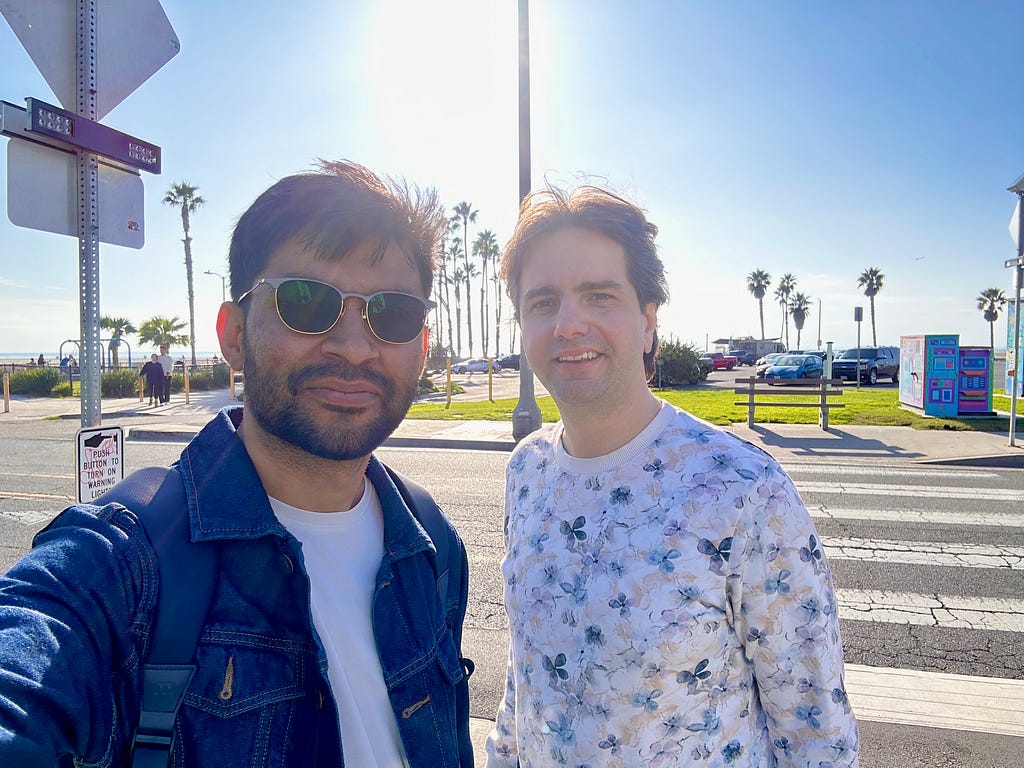
A Student-Researcher’s Journey: From USC Admission to USC-ISI Projects
Applying to USC
By December 2021, like many other aspiring graduate students, I applied to 10 to 11 universities and eagerly awaited the results. By early March 2022, I received an acceptance from the University of Southern California (USC). After considering all my options, I decided to join USC in mid-April, paid the deposit to confirm my enrollment, and USC created my official email account. This was the beginning of my journey.
Aiming for Research Opportunities
My goal was to join a research lab and collaborate with experienced researchers. I contacted current graduate students on LinkedIn to understand how I could achieve this at USC. They shared that obtaining a research assistantship at USC is highly competitive due to the large cohort size and advised me to contact professors directly using the USC email that I have.
By June 2022, I started emailing professors after gathering their contact information from USC’s website. Simultaneously, I connected with professors and research scientists on LinkedIn to improve my chances of receiving responses. I was determined to secure a research position before arriving in the U.S., so I focused on crafting personalized messages showcasing my qualifications.
Connecting with Professor Filip Ilievski
On July 7, 2022, I reached out to Professor Filip Ilievski on LinkedIn, introducing myself and expressing my interest in joining his research group at USC’s Information Sciences Institute (ISI). In my message, I highlighted my professional and research experience, emphasizing my skills and interests, and included a link to my Google Scholar profile to showcase my research work.
Professor Filip responded within two days. Although he had no immediate openings then, he mentioned that new projects might be available by the time I started my studies at USC. True to his word, on August 1, he followed up with an opportunity and invited me to complete an interview exercise for a potential position in his research lab.
The Interview Process
Professor Filip assigned me a three-day deadline to complete the interview exercise. Fortunately, it coincided with the final week of my job at the time, allowing me to dedicate my full attention to the task. I poured my efforts into crafting a thorough and polished submission, which I uploaded to GitHub before the deadline.
On August 5, I received encouraging feedback from Professor Filip. He appreciated the quality of my work and invited me to an interview to discuss the role further. As I had a farewell meeting with my team at my current job, we scheduled the interview for August 9.
The interview went smoothly, and the very next day, August 10, I received the exciting news that I was selected to join the Machine Commonsense Project as a research assistant. The position involved working 20 hours a week on cutting-edge research, and I was overjoyed to embark on this incredible opportunity.
Starting My Journey at USC ISI
I landed in the U.S. on August 12, 2022, excited to begin my journey with an on-campus research position secured. My first day at ISI was on August 18, when I started working on enhancing agents to play text-based games. Adjusting to a new country, balancing coursework, and managing research was initially overwhelming. Daily tasks like cooking and commuting added to the challenge. However, I gradually adapted by establishing a routine and seeking peer support, which allowed me to find my footing. Despite the hurdles, the experience strengthened my skills and prepared me for the journey ahead.
Research Projects and Publications
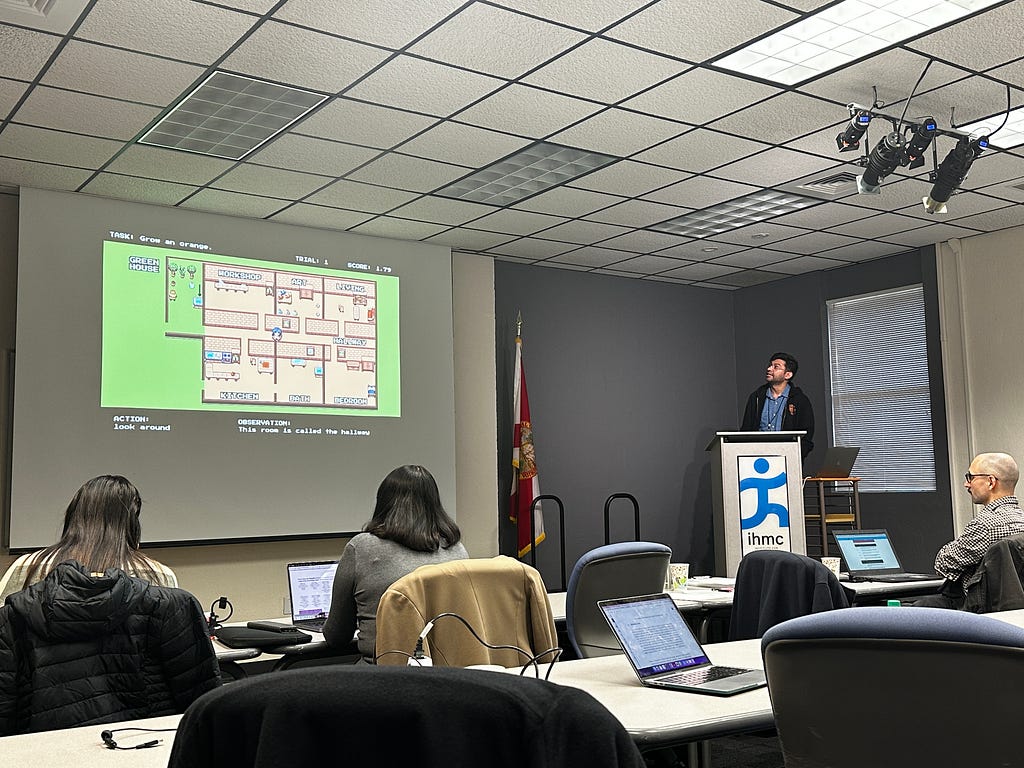
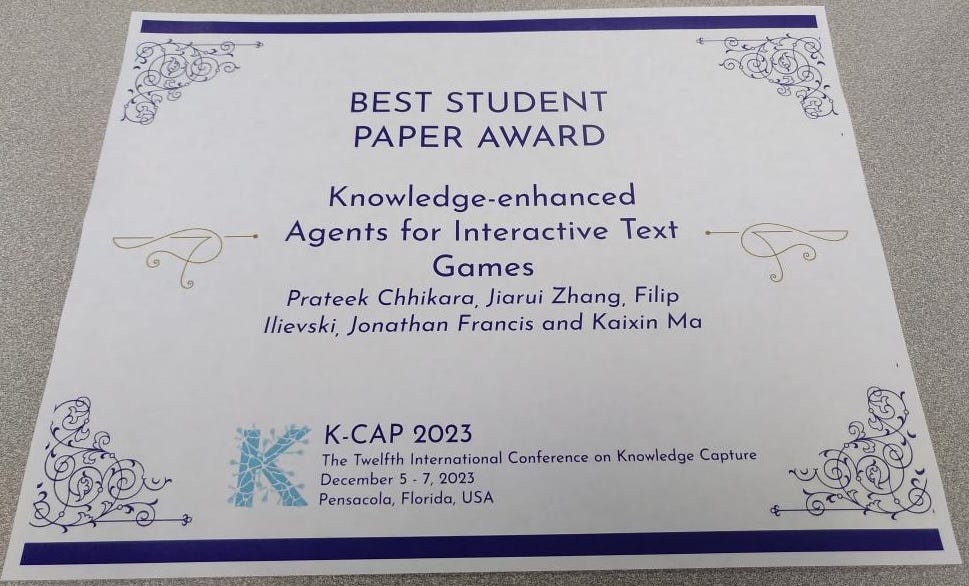
Over time, I gained proficiency in my domain, and by March 2023, significant progress was made on the text-based games project. We submitted a paper to ECAI in May, but it was rejected. Later, we improved the work and submitted it to K-Cap’23, where it was accepted. I had the privilege of presenting it and even won the Best Student Paper Award.
During the summer of 2023, I took on a second project under Professor Filip and Research Scientist Mahyar Khayatkhoei, focusing on Visual Question Answering (VQA). I balanced both projects, working full-time for 40 hours a week.
Meanwhile, a Deep Learning course project on food image-to-recipe generation evolved from a class assignment into a robust research endeavor. My team and I revised and polished the paper with Professor Filip’s mentorship, transforming it into a conference-worthy submission. The effort paid off when it was accepted at WACV’24.
The VQA project also yielded significant outcomes. We submitted an initial version to a workshop at NeurIPS’23, where it was accepted and presented by Jiarui Zhang, the first author of the paper. Building on this foundation, we developed an extended version of the research, which is now under review at ICLR’25.
Growth as a Researcher
Working at ISI unlocked doors to collaborate with esteemed researchers like Kaixin Ma from Carnegie Mellon University (CMU) and Jonathan Francis, affiliated with both CMU and Bosch. These collaborations enriched my perspective and exposed me to diverse research methodologies and insights. Over the course of 1.5 years, I significantly sharpened my research skills, including formulating hypotheses, conducting experiments, and analyzing results. Additionally, I improved my academic writing, enabling me to articulate complex ideas effectively. This journey also deepened my understanding of AI agents and LLMs, giving me a solid foundation in cutting-edge AI technologies and their practical applications.
Looking Back and Ahead
In December 2023, I concluded my journey at USC ISI as Professor Filip transitioned to Amsterdam. Parting ways with ISI was bittersweet, marking the end of a transformative chapter in my academic and professional life. Reflecting on my time there, I deeply value the experiences, challenges, and opportunities that shaped me as a researcher. The skills and relationships I gained continue to influence my work today.
Now, as a graduate working at an innovative AI startup, my focus has shifted to industry applications, leaving limited time for academic research. However, my passion for exploration remains strong, and I look forward to future opportunities to collaborate with Professor Filip and his team on groundbreaking projects.