More than Five years of steady work: reading, building, writing, and keeping at it.
https://scholar.google.com/citations?user=RQTJ_aIAAAAJ&hl
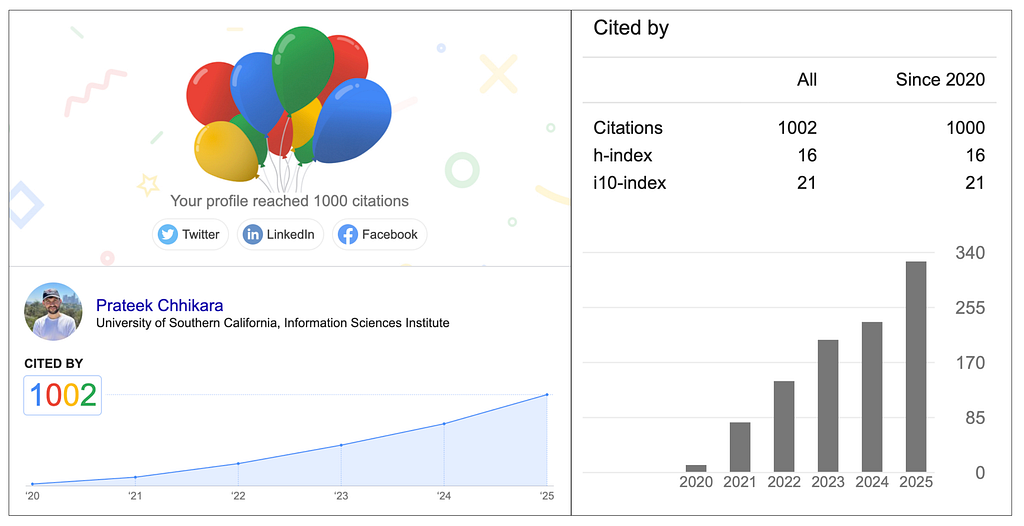
Today, 6th November 2025, I crossed 1,000 citations on Google Scholar with 25+ papers. I know, it is just a number, but to me it reflects years of steady work, drafting papers, submitting to conferences/journals, responding to reviews, and when a paper was rejected, improving it and trying again. This didn’t happen quickly; it grew over more than five years through small steps, patience, and consistent effort. I did this without a PhD, learning by doing and staying consistent. For me, today is both a celebration and a checkpoint, a moment to be grateful, then keep going. In this article, I would like to share that journey.
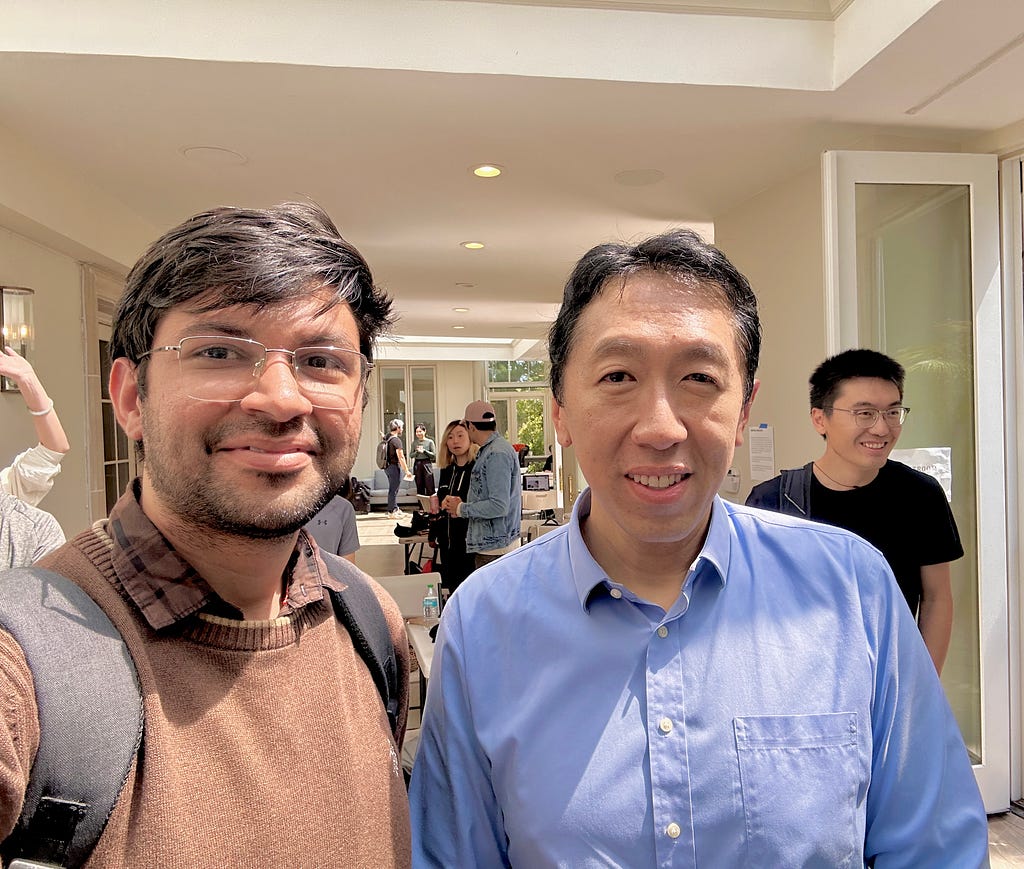
In my early undergrad at Thapar University (2016), I dreamed of studying in the U.S. In summer 2018, Andrew Ng’s Machine Learning (ML) course on Coursera lit a spark and piqued my interest in ML. That fall I took an ML class at my university and started reading what it takes to get into universities like Stanford: strong grades and research experience. Back then, “research” felt like something only professors did, I didn’t realize students could be part of it.
In early 2019, I met with three professors in my undergrad, Neeraj Kumar, Tarunpreet Bhatia, and Jasmeet Singh. They saw I was serious in doing research and let me join their research groups. We set up weekly check-ins, and I learned the basics of doing research the practical way: reading related work, setting up clean experiments, keeping logs, and turning results into clear figures and drafts.
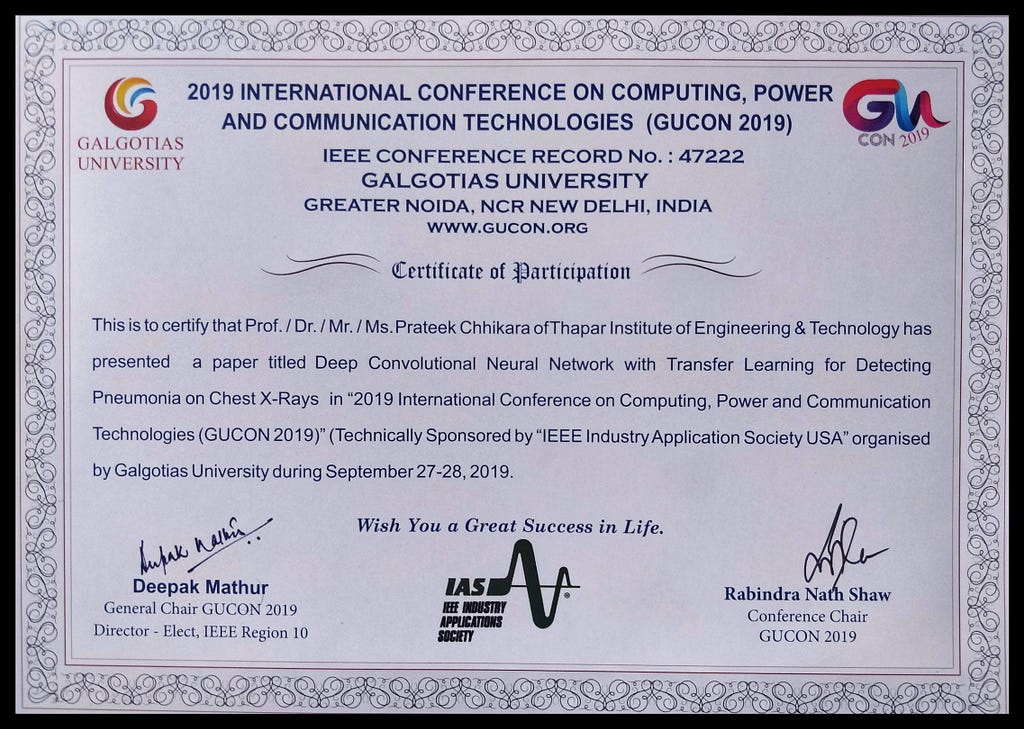
That spring I juggled three research projects at once while managing classes. By mid-2019 we sent all three papers out. One was rejected, so we revised and resubmitted. Another, with Prof. Tarunpreet, was accepted. In September 2019 I gave my first conference paper presentation in Noida. It was a short, focused presentation, but standing at the podium and answering questions gave me a real boost of confidence.
On September 15, 2019, I received an internship offer as well as full-time offer from Housing.com. With job hunting off my plate, I continued doing research on the side with Prof. Neeraj Kumar and Prof. Rajkumar Tekchandani, focusing on deep learning across CNNs, RNNs, attention-based models, and several custom setups. We held weekly check-ins, and I ran experiments and drafted the initial manuscript so the results would not just sit in notebooks.
2020 was my hands-on year. I built and trained models in Keras/TensorFlow and PyTorch, wrote eval scripts, and dug into failure cases. This was not the LLM or ChatGPT era, when things broke, I read docs and Stack Overflow threads, traced tensors line by line, and built tiny repro scripts to isolate bugs. I obsessively checked tensor shapes so each layer’s output matched the next layer’s expected input. Seeing activations, feature maps, and basic saliency made the models make sense, and it was genuinely fun.
I first chased research as a path to Stanford. Then the second-order effects took over: I was learning real skills, keeping up with new ideas (better backbones, smarter augments, cleaner training tricks), and the learning fed my job, faster experiments, better defaults, clearer metrics. The loop flipped: research helped work, and work sharpened the research.
By late 2021, after the GRE, TOEFL, and several rounds of SOP revisions, I submitted my applications with 12 co-authored papers and more than 150 citations. I did not get into Stanford. It hurt for a day, but it did not change my plan. I kept learning, devoting myself to research, writing papers, and collaborating with my professors. I chose the University of Southern California.
Before leaving my job at Housing.com in July 2022, I completed two additional papers that same year with colleagues, each derived from real projects we had deployed to production at the company. My rule was simple: if a problem mattered in production and we had a clear, reproducible fix or solution, we turned it into a paper so others could use it too.
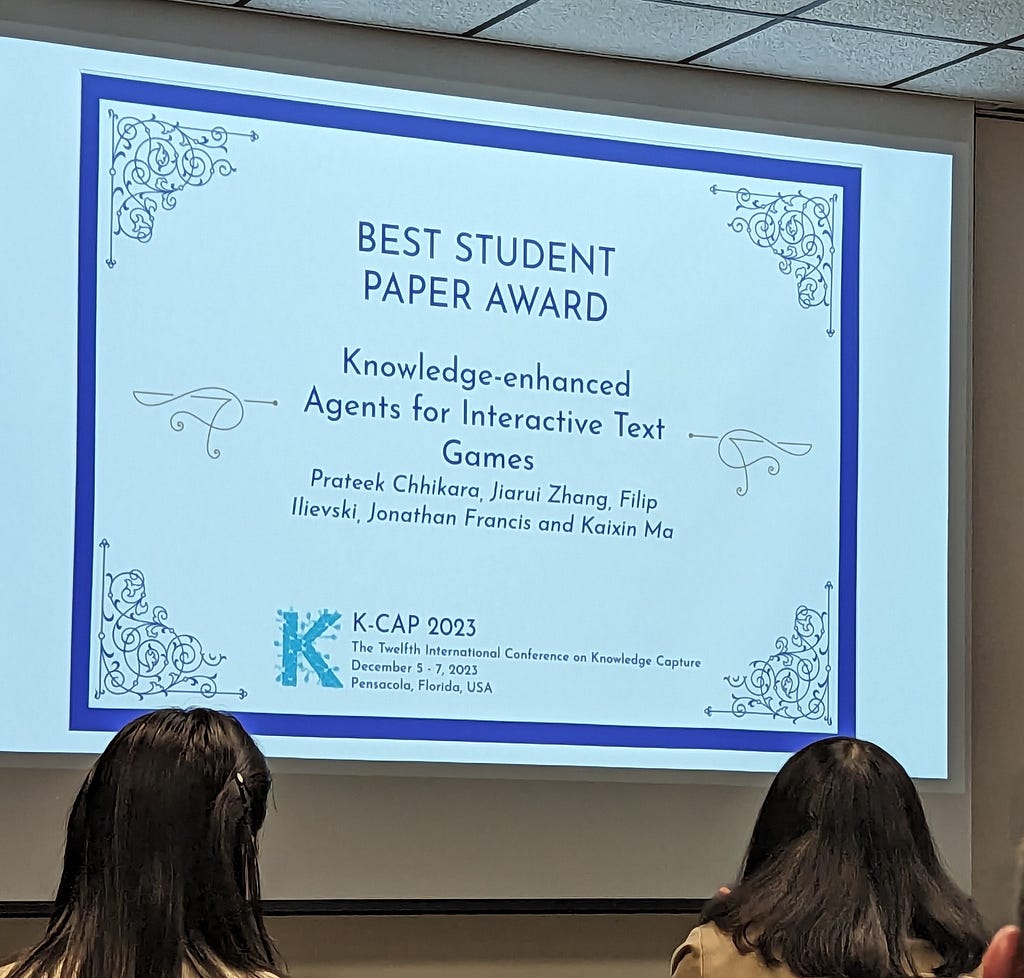
After coming to USC in August 2022, I worked with Prof. Filip Ilievski on text-based games and multimodal models. Our text-based games work, which I presented, won the Best Student Paper award at Knowledge Capture Conference in 2023. I was fortunate to work with Prof. Filip, and I learned how to frame research the right way: define clear research questions, design experiments that map directly to those questions, and write for the reader.
After graduation I stayed in touch with Prof. Filip, and we continue to collaborate.
In Spring 2023 I took Deep Learning and Applied NLP, and both courses had group projects with my friends. I suggested we turn those projects into papers because the problems were real, the baselines were fresh in our heads, and the class deadlines had already forced us to build clean, reproducible code. Publishing was a way to push the work one step further: define sharper research questions, run ablations we had skipped, write clearly for an outside reader, and get feedback from reviewers instead of just a grade. It also turned short-term course work into something useful for others. We did it: one became a WACV main-conference paper from the Deep Learning course, and one became an ACL workshop paper from the NLP course.
Here is what I learned, and what you can take away.
- Research takes time. A solid paper can take a year or more. Even good work gets rejected at top venues. Do not stress. Read the reviews, fix the gaps, improve the draft, and send it to another venue. Keep the focus on the work, not the outcome.
- Writing matters as much as the idea. A clear paper that explains the problem, method, experiments, and results will get attention. A messy paper will not, even if the idea is strong. I was not a great writer at first. I got better by outlining early, keeping figures simple, and revising until each claim matched the evidence.
- Collaboration widens your view. Teammates and co-authors bring ideas and tools you may not know. Brainstorming taught me new algorithms, even ones we did not use. Now I know they exist and when to try them.
Finally, I am grateful to my professors, my teammates, my classmates, and many collaborators who reviewed drafts, fixed bugs, and asked hard questions. None of this was solo.
What is next?
I have a full-time job now and still find time for research. It is slower, but the habit remains: pick a real problem, test ideas, and share what works.
Thanks for reading. If you are at the start of your journey: take the first small step, find a mentor, and ship something. The rest compounds.